
Ultrasound Probe Repair for Standard Transducers
OEM-quality repair of linear, convex, phased array and endocavity probes, inspected completely, documented in full, with a loaner included.
Six out of ten standard transducers that reach our bench have the same main problem: the acoustic lens. Not the electronics, not the cable. It is the one part that touches the patient and takes the wear.
That is good news for you. A lens repair is one of the most economical things that can happen to an ultrasound probe, and one of the most often misread, because a worn lens produces the same symptoms as far more expensive faults.
We have repaired over 10,000 probes. Since October 2024 alone, 254 distinct models from 16 manufacturers have passed through our workshop. Send us your probe and you get a full diagnosis before any quote, and a loaner is included while we repair it.
What breaks on an ultrasound probe: our repair data
These are not industry averages but our own figures. Share of standard-probe repair orders by assembly, since October 2024:
| Assembly | Share of repairs |
|---|---|
| Acoustic lens / window | 63 % |
| Housing / seal | 22 % |
| Strain relief | 17 % |
| Full reconditioning (ReGeneration) | 10 % |
| Diagnostic inspection | 9 % |
| Cable | 8 % |
| Electronics / array elements | 4 % |
| Connector | 2 % |
Shares add up to more than 100 % because many probes need more than one repair.
That last point matters when you plan a budget: 59 % of the probes we inspect have damage on more than one assembly. The most common pairs are housing plus lens, and lens plus strain relief. A quote that only covers the fault you noticed rarely tells the whole story. That is why we inspect the complete probe before quoting.
Repairs by assembly
Lens, housing, cable and strain relief: what goes wrong, why it happens and what we do about it.
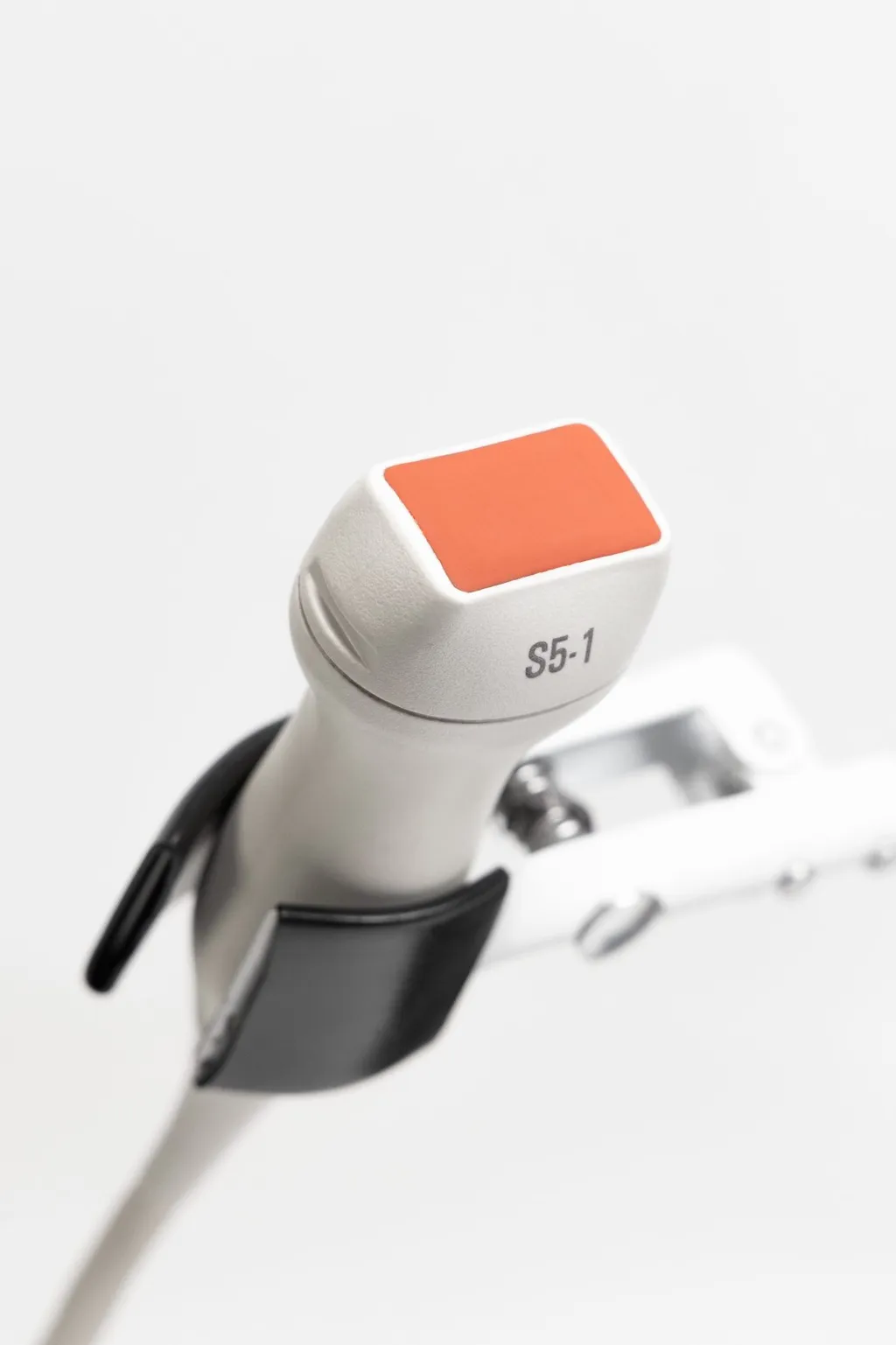
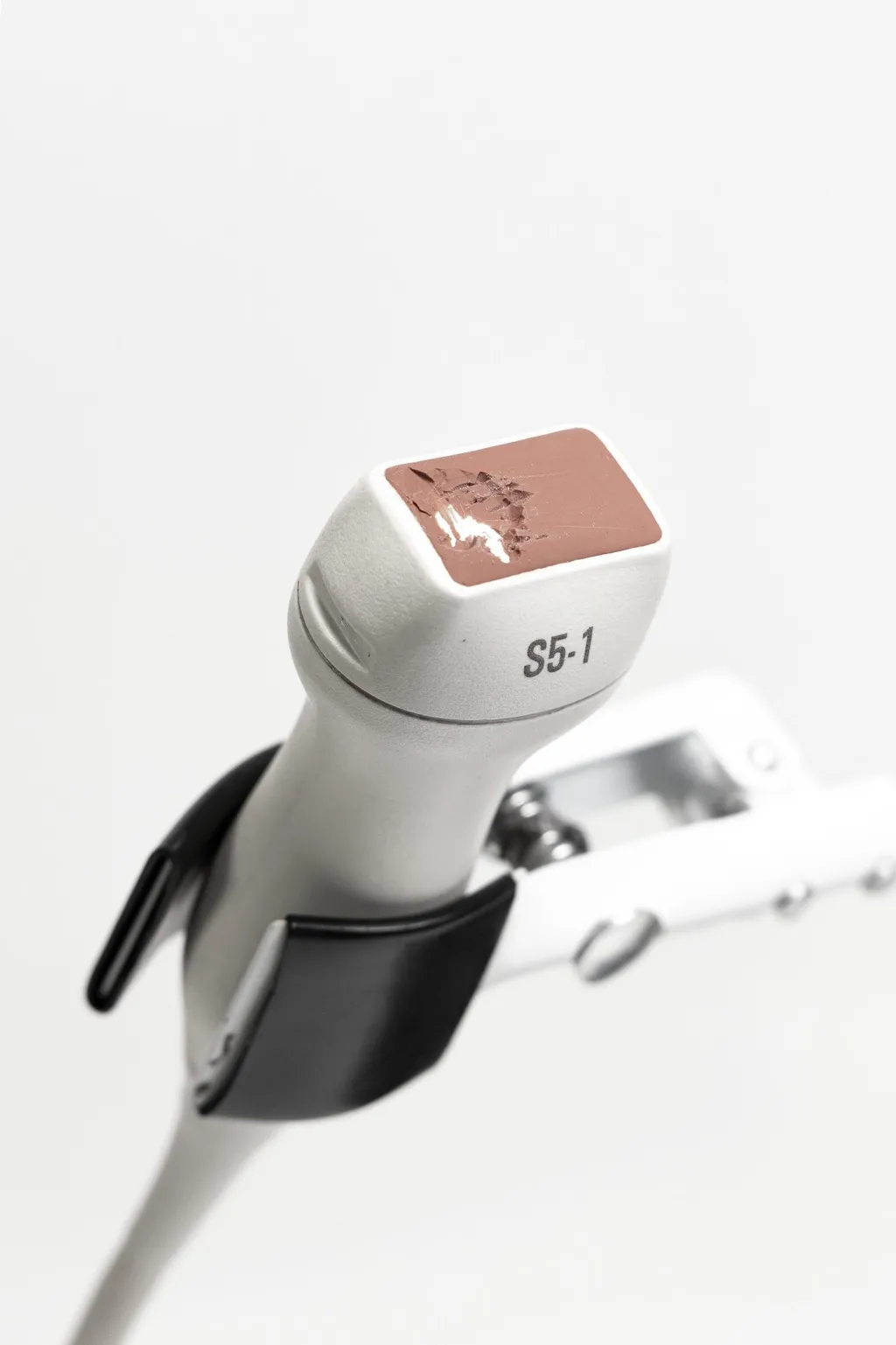
Acoustic lens repair
RequestCause: the lens is the wear layer. Disinfectants, gel, contact pressure and time break down the material and its bond to the layers beneath. Once that bond opens, air enters the acoustic path, and air is where ultrasound stops.
Repair: we remove the damaged lens, inspect the array underneath, grade the crystal condition and rebuild the acoustic stack. The crystal grade appears in your protocol, so you know how much life the array has left.
Limit: if array elements are already lost, a new lens will not bring them back. We tell you after the inspection, before you spend money on it.
Symptoms
- Image artefacts
- Reduced penetration
- Dropouts in the near field
- Visible scratches or delamination on the contact surface
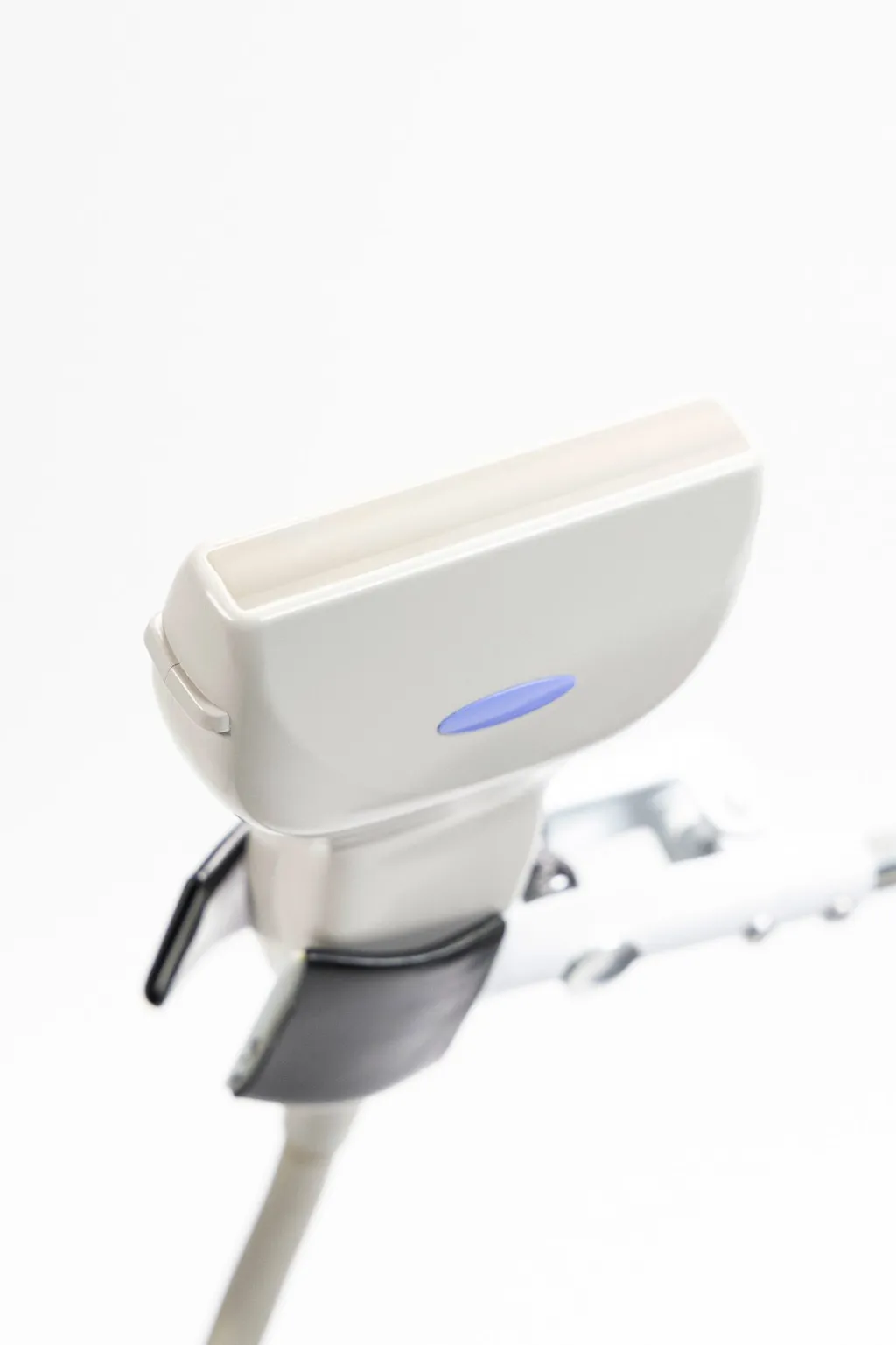
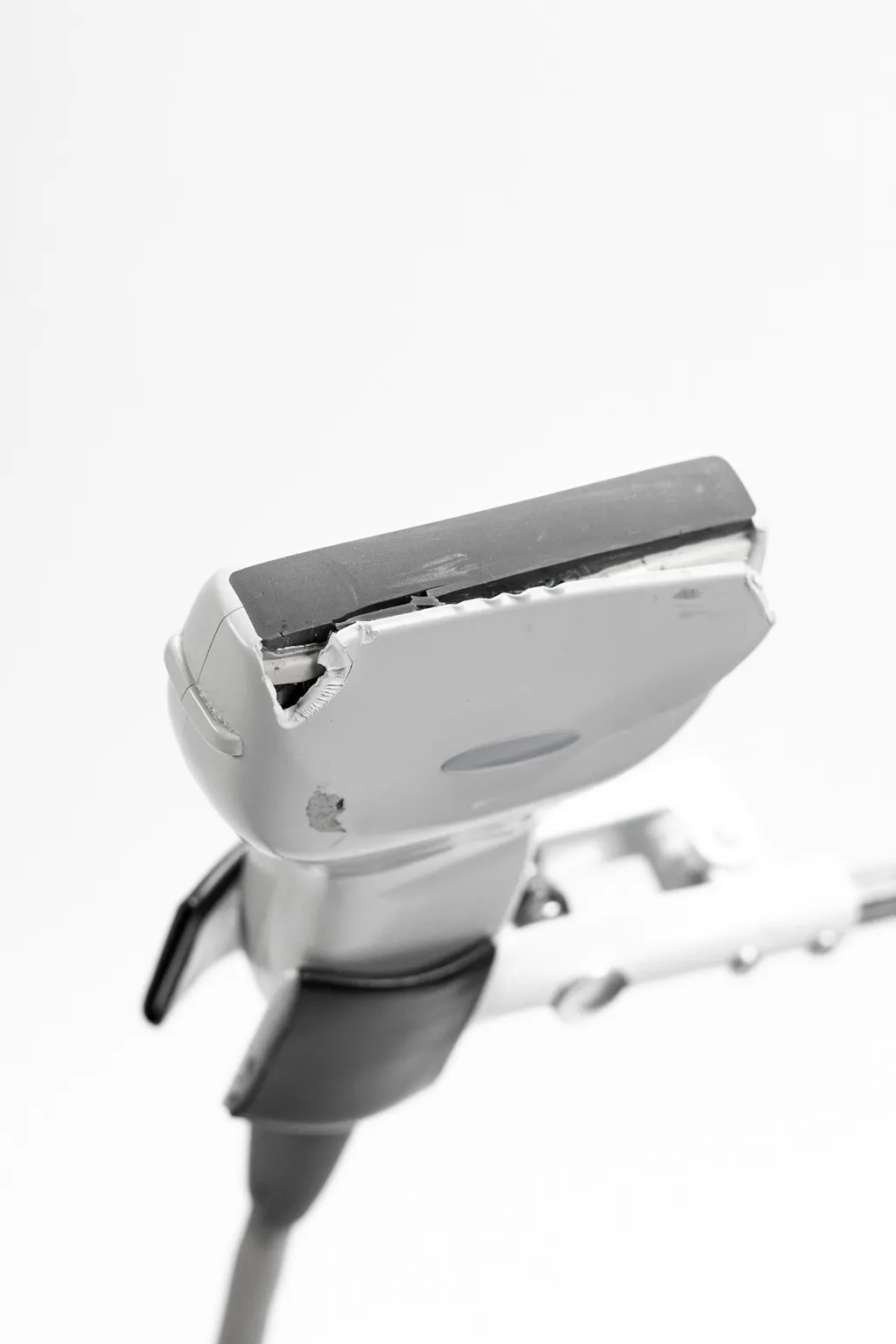
Housing, seal and fluid ingress
RequestThe second most common repair at 22 %, and the one with the highest follow-on cost if ignored.
A cracked housing or failed seal does not stop the probe straight away. It lets disinfectant in where it does not belong, and the damage travels inward over weeks: first the electronics, then the array. A housing repair is inexpensive. The damage it prevents is not.
What we do
- Reseal the housing
- Replace grip surfaces and buttons where needed
- Verify the result with an electrical safety test to EN 62353, with the measured value recorded in your protocol
Cable and strain relief repair
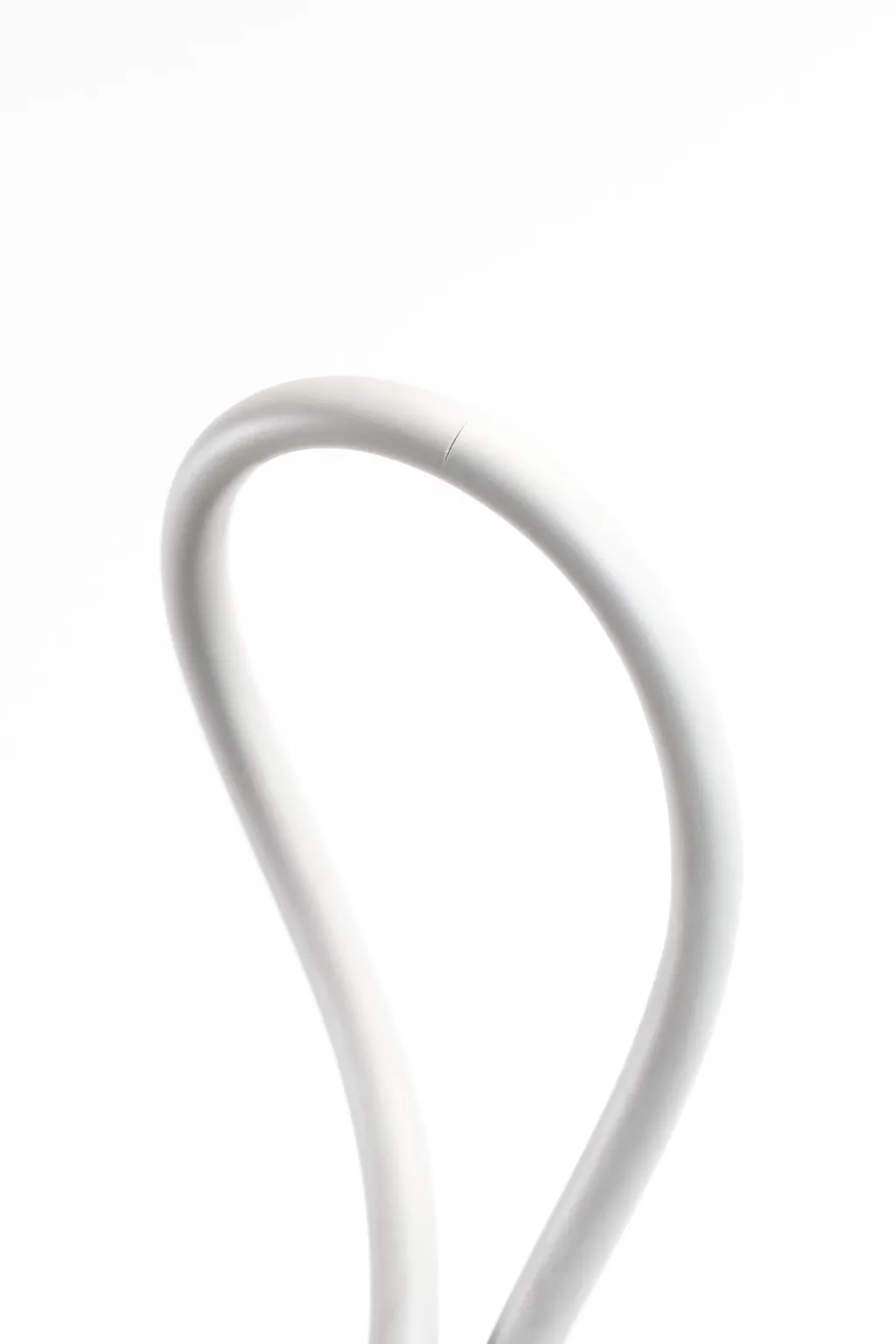
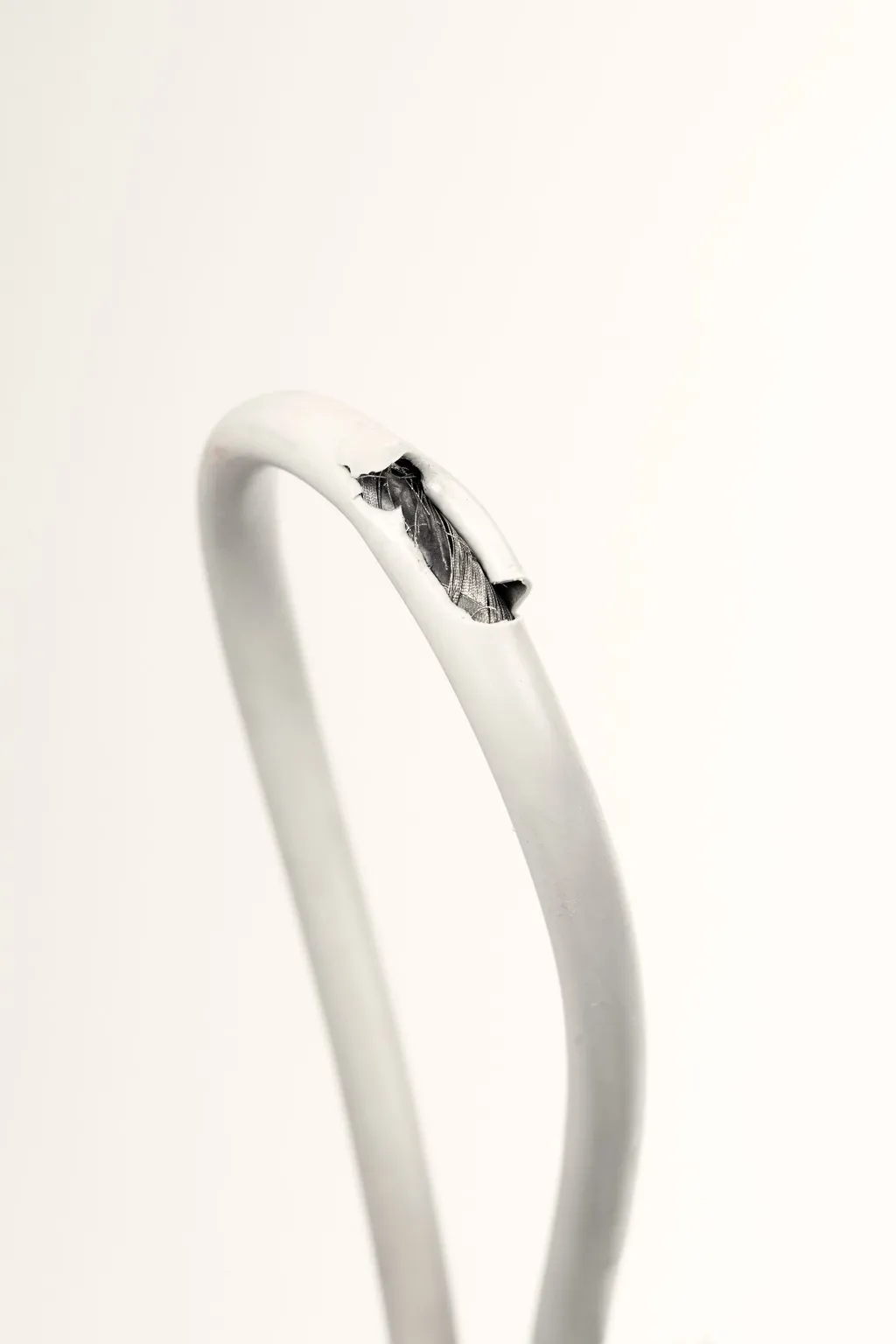
RequestStrain relief accounts for 17 % of repairs, the cable itself for 8 %. In practice they are one problem in two stages.
The bend protection at the probe and the connector takes every cart move, every drawer, every cable wrapped around the system. Once it hardens or splits, the cable harness inside flexes where it was never meant to. The result is the symptom people notice: intermittent dropouts when the cable moves.
Caught at the strain relief, it is a straightforward repair. Caught after the conductors break, it means a full cable harness replacement.
Electronics, array and connector
Together only 6 % of our standard repairs. It is the rarest category and the reason a proper diagnosis matters. From the operator's side, electronic faults look like lens faults: poor image, missing sectors, noise. Only a bench test tells them apart.
We test image quality, CW, PW and colour Doppler, system error messages, electrical channels and control keys. Connector faults (bent pins, a worn lock, a damaged contact board) can usually be repaired without touching the rest of the probe.
What OEM-quality probe repair means here
"OEM quality" is on every repair website. For us it means four verifiable things:
- Electrical safety to EN 62353 on every probe, with the measured value on record
- 35 check points per standard transducer, across six inspection stages
- Around 19 photographs per inspection, so every finding is visible, not just described
- An incoming and an outgoing protocol for every serial number, archived and locked against later changes
You keep both protocols for your own device documentation.
How to choose an ultrasound probe repair company
Whichever provider you use, ask these five questions:
- Do you inspect the whole probe, or only the reported fault? More than half of all damaged probes have more than one problem.
- Do I get a written protocol with measured values? "Passed" is not a measurement.
- Is a loaner included, and does it fit my exact system? Ask how compatibility is checked.
- What happens if the probe cannot be repaired? You should get the findings, not just a verdict.
- Which models have you actually repaired? A logo list is not experience.
We are happy to answer all five before you send anything.
Our repair process
Inspection
The complete probe, not just the symptom: overview photos, EN 62353 electrical safety, functional test, visual assessment of eleven components, summary and technician statement.
Report and quote
Findings with photos and a clear recommendation. If a repair is not worth it, you learn it here.
Repair
Only what you approved.
Outgoing inspection
A second, independent protocol before the probe ships.
Probes we repair
254 models from 16 manufacturers, weighted by what European clinics run:
GE Healthcare (34 %) · Canon Medical (Toshiba) (15 %) · Esaote (13 %) · Philips (12 %) · Samsung Medison (9 %) · BK Medical (6 %) · Hitachi, Siemens, Mindray, SonoSite and others (11 %)










Often on our bench: GE ML6-15-D, GE 3Sc-RS, Canon PLT-1005BT, Esaote AC2541.
All supported manufacturersProbe inventory & loaners
Specialised probes: TEE probe repair · 3D/4D probe repair
Frequently asked questions
Ready to Restore Your Probe?
Get a professional diagnostic assessment and repair quote within 24 hours
Explore Other Probe Repair Services
Specialized expertise across every major probe technology.
3D/4D Probe Repair
Bringing Depth Back to Your Diagnostics: Our technicians specialize in the delicate inner workings of volume probes, providing the high-tech care your most advanced imaging tools deserve.
Learn moreTEE Probe Repair
Protecting Patients and Performance Alike: Specialized TEE restoration that addresses every delicate detail, from insertion tube recoating to distal tip articulation.
Learn more